

On What Basis Are Animals Classified As Invertebrates
All insects are invertebrates!
All living things are placed into groups depending on mutual characteristics. The animal kingdom is informally divided into two groups, the vertebrates and invertebrates. Invertebrates are a grouping of animals that accept no courage, unlike animals such as reptiles, amphibians, fish, birds and mammals who all accept a backbone.
Classification or taxonomy is a means of arranging living things into orderly groups. These groups are mostly distinguished by construction and reflect evolutionary relationships. Standardised categories allow quick recognition of individuals and groups of like organisms.
There are 7 levels of classification, KINGDOM, PHYLUM, Form, ORDER, FAMILY, GENUS and SPECIES. The highest classification level "KINGDOM' incorporates organisms that share merely a few important features. Modern taxonomy recognises five kingdoms.
- Animalia (animals)
- Plantae (plants)
- Fungi (fungi)
- Procaryota (bacteria)
- Protoctista (algae, protozoans, slime moulds)
As you lot move down through the levels, organisms are grouped into smaller and smaller groups. Individuals within each grouping become more akin, until you lot are left with a grouping of still blazon of organism i.east. all the same species.
|
Level of Classification |
Related Groups at Each Level | |
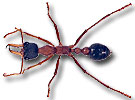
| KINGDOM | Animalia | All other multicellular animals eastward.one thousand. birds, mammals, worms, starfish |
| PHYLUM | Arthropoda | All other arthropods e.1000. insects, crustaceans, spiders, scorpions |
| Form | Insecta | All insects due east.thou. grasshoppers, bugs, beetles, flies, collywobbles |
| Social club | Hymenoptera | All other Hymenoptera only e.1000. bees, wasps, ants, sawflies |
| Family | Formicidae | All other ants, 95 Genera e.g. meat ants, green ants, sugar ants |
| GENUS | Myrmecia | Estimated 4000 species |
| SPECIES | desertorum | Other members of this species only |
| Common Name | Bulldog ant | |
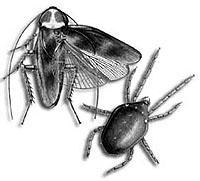
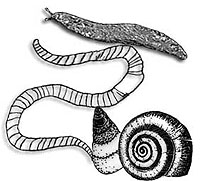
Over 95% of all animals on the world are invertebrates of one form or another. Invertebrates are found just about everywhere in both terrestrial and aquatic habitats, and include animals ranging from sponges, corals and seastars to insects, venereal and worms, just to name a few. For information on collecting aquatic invertebrates in freshwater environments run across the Waterwatch site. Over 80% of all invertebrates are grouped into the single phylum Arthropoda that includes spiders, crustaceans, centipedes, millipedes and insects. All arthropods share the following common features:
| |
|
| |
|
Invertebrates or Insects
Insects are dissimilar from almost other invertebrates. They are the largest Grade of organisms and account for over 75% of all animal species. Insects can be separated from other invertebrates as they more often than not have 6 legs and conform to a common body plan. This body programme comprises of iii parts, the head, thorax and belly although some parts may be more distinct than others. Particular insect orders may have some structures absent, reduced or greatly modified and some immature stages tin appear very different from their mature adult form.
How to place insects?
If you would like to identify insects then you must learn the parts of their beefcake. There are 3 chief parts which make up the body of an insect, each having a specific role.
The HEAD , which is designed for feeding and sensory purposes and consists of 1 pair of compound optics and upwardly to 3 simple optics, i pair of antennae and mouthparts, which may be piercing, chewing or sucking types depending on the insect.
The THORAX , which is designed and is made up of three segments with each carrying ane pair of legs. In some adult insects the last ii segments of the thorax may support a pair of wings depending on the species.
The ABDOMEN , which is designed for reproduction. The belly is the largest and softest of the 3 body parts. The abdomen houses all the organs vital for insect survival such every bit respiration, digestion and reproduction.
Life Cycles
Insects inhabit a diverse range of habitats, both terrestrial and aquatic and this is often reflected past the great variety in their appearance. Most undergo some degree of modify or metamorphosis during their life bicycle and young may not have all of the adult insect features such equally wings.
Some insects, such as silverfish bear witness no alter throughout their lifetime except for an increment in body size. While other insects such as bugs or grasshoppers go through gradual stages of development, each successive stage (or nymph) is slightly more adult than the previous one. For example wings begin to develop from minor wing buds and grow larger with each moult.
Other insects such as moths or beetles are typical of insects that undergo a number of abrupt changes as they mature; egg - larvae - chrysalis/pupae - developed. In insects such as these, the wings develop inside the trunk and are visible but subsequently the adult emerges from the pupal phase.
Source: https://www.ento.csiro.au/education/what_invertebrates.html
Posted by: edwardsperes1992.blogspot.com
0 Response to "On What Basis Are Animals Classified As Invertebrates"
Post a Comment