

How To Make Anime Full Body Characters In Blender
Update note: Eric Van de Kerckhove updated this tutorial for Blender 3.0 and Unity 2020.iii LTS.
Artists create 3D characters for your favorite games with the use of models, textures and animations.
In the by, characters needed to take the exact aforementioned skeleton to share animations. This limited graphic symbol diversity every bit their height and proportions had to exist the same likewise. As an amusing instance, the older FIFA games had players all be the same size because creating a split up skeleton — and a set of animations — would take been a nightmare.
Present, almost game engines come up with a organization to allow reusing animations every bit long as the skeletal hierarchy is compatible. This allows y'all to use the same animations for characters of all shapes and sizes. In Unity, this arrangement is called Mecanim. It allows for easy prepare of animations, the blending between them and retargeting of humanoid animations between models.
Being able to reuse animations allows you lot to use animations from the asset store and websites like mixamo.com for your own custom characters. This saves a ton of time!
In this tutorial, you'll learn how to prepare a humanoid model using Blender and how to bring it into Unity. More specifically, you lot'll learn how to:
- Create an armature (skeleton) for a grapheme and rig it
- Heighten the grapheme with accessories and objects
- Consign a model to FBX
- Import Blender models into Unity
- Create and tweak a humanoid avatar
- Attach objects to a character
- Animate a humanoid in Unity
Time to leap right in!
Getting Started
Earlier you brainstorm, verify you encounter the following requirements:
- Yous've downloaded and installed the latest 2020.3 LTS release of Unity.
- The latest stable 64-bit version of Blender is installed on your machine.
- You accept a minimal understanding of the Unity editor. Check out some of the beginner tutorials on the website.
- Some experience with Blender is recommended. Hither is a good tutorial to get started.
Download the source materials by clicking the link at the top or bottom of this tutorial and unzip information technology somewhere.
Open the Starter folder and navigate to the Assets\RW\Models folder. At present open CuteCharacter.alloy in Blender.
The file contains the following:
- A low poly humanoid grapheme model
- The CuteCharacter fabric
- A reference to the CuteBase texture independent in the same folder as the model
After opening the file, you should meet the character model on the left:

Note that information technology's mirrored on the X-axis, meaning its left and correct side are identical. This will make the whole procedure a lot easier forth the way.
The right side of Blender has a simple texture image loaded:

Fourth dimension to get to work! The first footstep to animating this graphic symbol is rigging it.
Rigging the Character
Rigging is the art of creating an armature, the skeleton of the model. An armature has basic to which y'all tin connect vertices, so they move along whenever a bone gets moved around.

Hover over the 3D View to bring it into focus. Now add together a new armature by property Shift and pressing A to open the Add together Menu. Side by side, select Armature to add the first bone.

You've now created the armature and its first bone, also known as the "root bone". With the armature still selected, notice the In Front check box in the Viewport Display section of the Object Backdrop tab and cheque it.

The armature is now visible through the graphic symbol making the skeleton creation process a lot easier.

Before diving in and creating the full skeletal structure, it'due south important to understand how information technology needs to be prepare to exist compatible with Unity's Humanoid Avatar.
Due to the way Unity maps the basic to its ain system, some fundamental basic are necessary.

Unity expects at least fifteen bones, which are:
- Hips (root bone)
- Lower spine
- Upper spine
- Neck
- Caput
- Two upper arms
- Two lower artillery
- 2 hands
- Two upper legs
- 2 lower legs
The rig y'all'll exist creating includes all of the above bones and some extra ones for added stability when animating.
Make sure the armature is still selected and printing Tab to enter Edit way. Next, select the root bone by clicking information technology.

Now open the Bone Properties tab on the right in the Properties editor and rename the root bone to Hips past entering information technology in the name field and pressing Enter.

Spine
With the offset os made, you can now transform it into a spine for the character.
Select the bottom, sphere shaped connector of the Hips bone. Side by side, printing G, Z, 0.5 and Enter in sequence to movement it up around where you'd expect the heart of the hips to exist.

Now, select the top connector and press Yard, Z, 0.1 and Enter to motility it up a bit.

Note: If it's difficult to see what you're doing, y'all can zoom in and out using the whorl wheel.
To become more spine bones, y'all'll need to subdivide the Hips bone in iii pieces. Select the Hips bone, correct-click to open up the context menu and select Subdivide. By default, this makes a single cut, splitting the bone into two pieces. To increment the number of cuts, open the Subdivide carte at the lesser left of the 3D view and prepare Number of Cuts to ii.

With the spine separate, the new bones are named Hips.001 and Hips.002. That'southward not a good way of naming bones; rename the bones by selecting each one and changing the name in the Os Properties tab of the Properties editor on the right like you did with the Hips os.
Proper name the pinnacle one Breast and the eye 1 LowerSpine.

Legs
Next upwardly are the leg basic. Duplicate the Hips bone past selecting it and so pressing Shift + D. Adjacent, movement it a tad to the right and right-click at the cease to reset the position of the new os.

If you expect at the Bone Backdrop tab on the right, you'll see a os named Hips.001 selected.
Note: Is the bone named Hips.003? In that case y'all might have forgotten to rename the other bones! No worries, yous can rename the bones now and then use the Outliner console at the top right to find and select your newly created os again.
Rename this bone to UpperLeg.50. The 50 stands for left, this makes it clear what side the bone is on and will assistance with mirroring after on.
This bone needs to point down and be placed right in a higher place the human knee. To start off, rotate the UpperLeg.L os 180 degrees on the Y axis by pressing R, Y, 180 and Enter in succession.

Now motion it in identify horizontally by pressing G, Ten, .23 and Enter in that order. After that, press G, Z, -.2 and Enter to get it in position vertically.

Select the bottom connector and movement it down by pressing K, Z, -.3 and Enter in that order.

You now have ane large bone for a leg. If this character had wooden peg legs, this would've been perfect already! Near people have knees and then they can bend their legs though, then yous'll need to make information technology bendable.
To do that, select the UpperLeg.50 bone, correct-click and select Subdivide to separate the leg in 2 (ouch!). This results in ii leg bones with a connector in the middle that will human action a knee. Go alee and the new bottom bone LowerLeg.L.

The last part of the legs are the feet. Switch to a side view by pressing 3 on your numpad and press period (.) on your numpad to focus on the lower leg.
Notation: Don't accept a numpad? Y'all can click X-centrality on the viewpoint gizmo at the peak right of the 3D view to rotate the view to the right. To get a better view of the leg, zoom in using your ringlet bike.


Now select the bottom connector and extend it to brand a foot os past pressing E, Y, -.eighteen and Enter.

Next, rename the newly created bone to Foot.50 using the Bone Properties tab.
Now might be a good fourth dimension to save the file. Printing CTRL + Due south and y'all'll detect a small-scale notice appearing at the bottom of the window. Feel complimentary to exercise this periodically, better prophylactic than sorry!

Switch dorsum to the front end view by pressing 1 on your numpad. Before moving on to the head, you'll need to parent the leg to the hips. Luckily this is pretty unproblematic!
Select UpperLeg.L and aggrandize the Relations section of the Os Backdrop tab. Click on the Parent drop-down and select Hips.

Torso
On to the head! Select the connector at the top of the Chest bone, printing E, Z, .055 and Enter consecutively. This is the neck bone so name it Neck in the Bone Properties tab.

To add together the head bone, keep the top connector selected and press Eastward, Z, .95 and Enter in that lodge.

Proper noun the newly created os Caput.
Next is the left shoulder connector. Select the top connector of the Chest bone and press Eastward, Ten, .08 and Enter to add the new bone. Move information technology downward a chip by selecting the rightmost connector and pressing Thou, Z, -.09 and Enter.

Name this os ShoulderConnector.L. This bone will connect the chest to the shoulder. None of this is anatomically correct in any way, and information technology doesn't need to exist. :]
Side by side up is the arm itself! Select the rightmost connector of ShoulderConnector.Fifty and press E, X, .85 and Enter in that order. This creates ane large bone that needs to exist separate to create the remaining basic for the left side.

Select the newly made arm bone, right-click and choose Subdivide in the context menu. Modify the number of cuts in the bottom left to 3, so you get four pieces in total.

Name these basic as follows, from left to right:
- Shoulder.L
- UpperArm.Fifty
- LowerArm.L
- Hand.L

The fashion these bones are laid out might look skillful at offset glance, but because the style the connector between the arm pieces sits (also known as an elbow), the arm won't be able to curve correctly. Hold Z to open the shading carte and drag your cursor to the left to enter the wireframe view.

Now accept a look at the bend in the arm:

The red line indicates where the elbow is now and the white line indicates the arm'south bending betoken on the mesh. To fix this, select LowerArm.Fifty and movement it to the right past typing G, Ten, .09 and Enter.

Now switch back to Solid rendering by holding Z and moving your cursor to the right.
That'southward it as far equally adding bones goes. How about the right side though? Well, I don't know about you, merely I'll take any shortcut I tin can become to get the piece of work done! That'south why the side by side step is mirroring the bones on the left to the correct with a few keystrokes.
Mirroring
Blender has a not bad feature to quickly mirror the bones of an armature in simply a few simple steps! To outset off, deselect all bones by holding Alt/Pick and pressing A. Next, select the bones on the grapheme's left side (the right side when seen from the front) past holding Shift and clicking the basic one-past-one. Don't forget virtually the foot!

With those bones selected, right-click and select Symmetrize in the context menu. This is all you demand to do to go a perfect mirrored version of the selected bones:

The basic will also all have .R automatically at the end of their name instead of .50 to signify what side of the body they're used for.
Now salve the file and gear up to motility on to rigging.
Weight Painting
Weight painting is the process of binding bones to a 3D mesh. Each os gets attached to a grouping of vertices with a certain corporeality of weight.
The weight decides how "hard" the vertices will be pulled and pushed by the bone.

Doing this manually would take a while since you'd have to pigment the weight of every single os. Luckily, Blender can have care of nearly of the grunt work past automatically weight painting based on how close the bones are to the vertices. This works by parenting the model to its armature and letting Blender automatically assign weights.
Printing Tab to switch to Object mode. Click on the character model to select it, then hold Shift and click the armature to select that as well. The order you do this in is important, as the concluding selected object will be the parent. Now printing CTRL + P to open the Parent bill of fare and cull With Automatic Weights to parent the model to the armature and perform automated weight painting.
On to the cool part! Select the armature, so change to Pose manner with the drop-down at the meridian left. At present select a bone and rotate it effectually past pressing R and moving your cursor around. Exercise this with each bone on the centre and the model'south left side to check if everything the basic were weighted correctly.

Afterwards checking all of the bones, you may accept noticed the eyes don't movement with the head, which looks a scrap weird, to say the to the lowest degree!
To attach the eyes to the head, y'all'll need to do some actual weight painting. Continue the armature in Pose mode, then agree Shift and click the model to add it to the selection. Now enter Weight Paint mode and ready to exercise some painting.

This style shows both the bones and the weight attached to them on parts of the model.
Start off by deselecting all basic by pressing ALT/Selection + A. Next, agree Shift and click on the Head os to select it. The weight colors become from dark blue, to green and finally ruby. As y'all can encounter, the optics are dark blue, which means they aren't attached to the head bone at all! To attach those eyes to the caput bone you'll demand to increment their weight.
For easier access to the optics and to strengthen the result of adding weight, rotate the head os backward by pressing R, X, -ninety and Enter in that order. It looks grizzly, simply don't worry, he won't experience a thing!

To attach the eyes to the Head bone, it needs some weight added to information technology. To start off, select the Add brush in the Brush section of the tool panel at the meridian left. By default, this is fix to Subtract.

Now paint on the eyes to increase the weight until the eyes aren't floating anymore.

To check out the event, reset the view by pressing numpad i and press Alt (or Option) + R to reset the rotation of the Head bone. The eyes are at present correctly continued to the head.

Notation: The rotation above was done using trackball rotation. You can activate this rotation manner by pressing R 2 times.
With the basic weight painting done, it'south time to add some details.
Calculation Accessories
Accessories in this context are objects that are attached to the graphic symbol but aren't a part of its body. This section discusses two means of attaching objects: to the model itself and as a split up, reusable object that connects to a bone.
The former is a elementary lid, and the latter is a weapon for the character to hold.

Before continuing, press A two times followed by Alt (or Choice) + R to reset the rotation of all bones.
Editing the Character
The first way of adding more details to your character is easier to work with, but it comes with some limitations. As y'all'll be working on the model itself — which is mirrored — all geometry added will be copied from the left side to the correct and vice-versa. This makes it impossible to add anything unique to ane side. Because the geometry is a office of a particular model, it also can't exist reused for other characters. It'due south perfect for any situation where those limitations aren't a problem.
If you've followed along with the tutorial until now, yous'll probably nevertheless exist in Weight Paint mode. Press Tab to enter Edit mode and outset off past switching the selection mode to Vertex by pressing 1 on your number row or by clicking the start button right of the manner dropdown.

Now select any vertex higher up the ruby-red line (which is an UV seam used for texturing) on top of the caput by clicking on information technology. Next, printing CTRL + Fifty to select all connected vertices, this selects the whole model. Now select the UV delimiter by selecting UVs in the bottom left console. The summit of the head volition exist selected now.

Select the edge loop underneath also by holding Shift and Alt (or Option) then clicking on whatever of the kickoff horizontal edges below.

Now duplicate the selected faces by pressing Shift + D and then clicking. Movement the duplicated faces up a bit by pressing Chiliad, Z and 0.01 followed by Enter to confirm.

Next, scale the whole selection up by pressing S, 1.05 and Enter. This moves the chapeau away from the head a bit, and so you don't end up with some of the faces Z-fighting.
The hat is nevertheless floating around, so do the following to attach it to the model:
- Select but the lesser row of the "lid" by pressing ALT/Option + A to deselect everything. At present select the bottom edge row of the hat past property Alt (or Option) and clicking on one of the bottom edges.
- Make information technology straight by printing South, Z and 0 in that gild.
- Press E to extrude and printing Enter to confirm.
- Printing South to start scaling and movement your cursor towards the model until the edges are within of the head. Rotate the view around to make this easier to run across. Click to ostend the scaling.

This gave the hat some depth so information technology tin can look all correct from all sides without whatever holes. A hat made from human skin probably isn't what you had in mind though! To change the color, you'll have to unwrap its UVs offset and then it can fit nicely on the texture.
Select the entire chapeau past selecting whatsoever vertex on the lid and then pressing CTRL + Fifty. Change the delimiter to Normal this time to select all the connected vertices. For this hat, you'll perform i of the easiest unwraps in existence: from the current view. Press numpad 1 to get a front view, then press U to open the Unwrap menu and select Projection From View.

If y'all look at the correct side of the Blender window where the texture is visible, you'll notice some vertices were added that look like to half of the lid:

You can select all of these by moving your cursor over to the texture and pressing A. Actions in Blender are context sensitive depending on where your cursor is placed, and so brand sure to keep it somewhere inside the region of the texture for now.
Now printing G to movement the UVs over to the blue splotch, confirm the motion past clicking and then scale the choice down until it fits inside the bluish region past pressing S and confirming by clicking again.

If you now look at the graphic symbol again, you lot'll discover his hat turned blue!

Now, position the cursor dorsum somewhere near the model on the left and printing Tab to return to Weight Paint way. Rotate the Caput bone around a bit to check if the hat is continued.

It looks like you're in luck! Considering the vertices of the hat are all so almost to the Head os, they're included automatically. If this wouldn't be the case, yous'd have to paint the hat like you did with the eyes.
Next up is creating and attaching a split object.
Attaching Objects
For this role, you'll be creating a simple staff that will human action as a weapon for the character to agree. It's easy to imagine a sword, an axe or even a magic wand instead, just creating a complex weapon is exterior the telescopic of this tutorial.
Get into Object mode and press Shift + A to open the Add menu. Select Mesh > Cylinder to add a new cylinder to the scene.

The default cylinder is too large, and so adjust the cylinder parameters in the bottom left: change Radius to 0.04 and set the Depth to i.ii.

This makes the cylinder thinner and shorter. Now brand the cylinder polish by right-clicking to open up the context bill of fare and selecting Shade Smoothen.
The cylinder doesn't take whatsoever material assigned yet, so it looks grey and bland. To assign a cloth, open up the Material tab in the Properties editor on the right and select CuteMaterial from the driblet-downwardly side by side to the New push.

To turn the cylinder into a brownish staff, you'll demand to unwrap its UVs starting time. Press Tab to enter Edit mode, printing U to open up the Unwrap carte du jour and select Project From View.
Movement your cursor over the texture on the correct, press One thousand to start moving the UVs and movement it over the brown patch on the texture. Ostend the movement with Enter and calibration it down by pressing S and moving your mouse, so the UVs fit inside.

The staff is now brown colored. Don't worry about the awkward positioning; you'll be dealing with that adjacent.

Open the Object Constraint Properties tab in the properties editor. Add a new constraint by clicking the Add Object Constraint drop-down and selecting Child Of.

Constraints limit the position, rotation and/or scale of an object. In this instance, it'll be used to parent the cylinder to the paw bone of the character. This way — if y'all create whatever animations — the object volition be attached to the hand at all times. This makes previewing the animation a lot easier and allows you to prevent the object from intersecting with the body.
Setting up the Child Of constraint is straightforward. Click the Target drop-downwardly and select Armature. Now click the Os drib-downwards and select Hand.R. You tin can type the proper noun of the bone in this fields to brand selecting it easier.

After doing this, you lot'll notice the staff snaps to the character'south right hand. The position isn't quite right though, and then movement it frontward a bit past pressing G, Y, -0.four and Enter. Much better!

Time to put the staff to the test. Select the armature and switch to Pose fashion. Now rotate the view so you lot can see the staff clearly, select UpperArm.R and rotate it effectually a bit by pressing R and moving your mouse around. The staff will keep following the hand around as if the character held it.

The character and its accessories are now done. Save the file and pat yourself on the back for a job well done!
Next up is exporting the model and the armature to Unity.
Exporting to Other Formats
Note: If you're not interested in exporting models to other formats so you can share them with other people, feel gratuitous to skip this section. But save the file and close Blender.
Unity tin can handle Blender'southward .blend just fine equally long as Blender is installed on the system. Nonetheless, when sharing models with different people, information technology's often better to use a format similar .FBX or .OBJ that doesn't require whatever other software. That'due south too the reason why most of our tutorials come with .FBX model files instead of .alloy files.
Exporting to FBX with Blender is piece of cake. To commencement, select File > Consign > FBX (.fbx) in the top menu.

You lot'll now see a Blender File View window. You can choose a location to save the file past choosing a folder on the left or by typing in the location directly at the top. The export settings are at the correct side of the window:

These default export settings will work with Unity, but there's a run a risk they might brand a mess in more complex scenes as it volition consign everything, fifty-fifty lamps and cameras. To make a make clean export, make the post-obit changes:
In the Include section, deselect Camera, Lamp and Other. Y'all tin do this by property downwardly Shift and clicking the options you want to disable.

With these options selected, yous won't get whatsoever undesired objects exported. Now check the Use Transform checkbox at the bottom of the Transform department. This applies the position, rotation and scale of all objects. That ways any non-uniform values volition exist reset; if the rotation was set to (X:23, Y:125, Z:vii), for example, information technology will be set to (10:0, Y:0, Z:0).

Side by side, open the Armatures section, check But Deform Basic and uncheck Add together Leaf Bones. This prevents Blender from adding extra bones to the armature. Leaf bones are simply needed for compatibility with Maya. Non-deform bones like command bones are only needed in the modeling software to make precise adjustments; they're useless in a game engine like Unity.

The default Animation options are fine, so yous don't need to tinker with those.
Now that you have all of this fix, it would be tedious if y'all needed to exercise this every unmarried time you want to export a file. That'south where the presets come in. You can save all of these settings in Blender's internal options for subsequently utilize.
To do this, click the + button side by side to the Operator Presets driblet-down at the peak, type a name for the preset in the textbox and click the OK button. For the sake of this tutorial feel free to name it Unity FBX.

If you lot now open the Operator Presets drop-down, you can select the newly made preset:

Doing and then will instantly utilize the settings. This works across all files, so from now on you tin can export whatsoever Blender file to FBX for use in Unity. The final step is the actual exporting. This tutorial uses the .blend file in Unity for animative, so feel gratuitous to save the FBX file anywhere you want by selecting a binder on the left and pressing the Export FBX button at the superlative right.

Save the file and close Blender. Information technology'southward finally time to jump into Unity and employ the model!
Setting Upward a Humanoid
Open the starter project in Unity and look at the Avails folder in the Project view.
Here'southward a quick overview of what these are for:
- Animations: Contains a simple idle animation.
- Materials: The materials of the character and the dojo.
- Models: Here'south where you edited and saved the character. It also includes the dojo model and some textures.
- Music: An Asian inspired song to get into the dojo mood.
- Scenes: The Dojo scene.
If information technology's not already open, open the Dojo scene from the Scenes binder.

With the overview out of the fashion, on to using the character!
Avatar Mapping
To starting time, select the CuteCharacter model in the Models folder and open up the Rig tab in the Inspector. Open the Animation Type drop-down and select Humanoid.

This flags this graphic symbol every bit a humanoid ane, so Unity tin use it as such. Now click Utilise to save these settings.
After a curt re-import, you'll discover the Configure… button is at present enabled. Click this push to start linking the basic to Unity's Mecanim system.

Wait at the Scene view and rotate the view around until the character faces you. Detect the green bones; these are the ones Unity uses internally. Clicking whatsoever of these will select the corresponding os in both the Bureaucracy and in the Inspector.

The way Unity uses these bones is past acting similar a puppeteer. Instead of straight upward using animation files to update the bones every frame, information technology reads the values and applies those to every humanoid based on their Avatar definition. This allows for flexibility when it comes to trunk shapes. Take the character you've been working on, for case; its proportions are non realistic, but that doesn't affair every bit its skeleton is also adapted to fit while still having the essential bones similar a spine, arms, legs, etc. Some of the bones may be shorter than in most humans, but they're there.
At present focus on the Inspector, you'll come across a human being shape with light-green and gray circles spread effectually. All solid circles are necessary for the Avatar system to piece of work. If any of these are missing, they'll plough red, and you won't be able to animate the graphic symbol correctly.
The dotted ones are optional bones for more complex rigs. Any body parts that are grayed out are missing, but non essential. This character doesn't accept any fingers for instance.

Below that is the full overview of the bones, and this is where you demand to link torso parts to bones. If any of the circles are red, you'll demand to (re)assign a os. The skeleton you've made is entirely up to spec when it comes to Unity, so no adjustments are necessary. Hurray!

Switch to the Muscles & Settings tab at the top of the Inspector. This allows y'all to view and tweak the virtual muscles.

Y'all'll now run into iii sections:
- Musculus Group Preview
- Per-Muscle Settings
- Boosted Settings
The commencement i has several sliders you can move from left to correct to test if the muscles are mapped correctly. Endeavour them out and see what they do. Notation that the finger ones won't accept any effect since the character doesn't have any fingers. Press the Reset All button later every test to reset all preview sliders.

The Per-Muscle Settings department contains sub-sections that can be unfolded by clicking the arrow side by side to them. Every one of these has some more specific previews and allows you to specify the minimum and maximum angles to preclude overlapping for your specific model.

Expand the Left Arm section and try sliding around the Arm Downward-Up slider. Discover what happens with the minimum value selected:

The arm is moving through the graphic symbol'due south body. Ouch! To fix this, set the preview slider to its lowest value and change the minimum angle of Arm Down-Up to -twenty.

Exercise the same for Correct Arm > Arm Down-Upwardly.

That concludes the tweaking of the muscles. At that place are more muscles y'all can tweak to foreclose overlapping, but for the sake of this tutorial you can leave them at their default settings.
Press the Employ button at the bottom-right to save the changes to the Avatar and press Done to close the mapping style.

Now it'south fourth dimension to add together the character to the scene and give it an animation to play.
Using the Character
To add the character, elevate the CuteCharacter model from the Models folder into the Hierarchy.
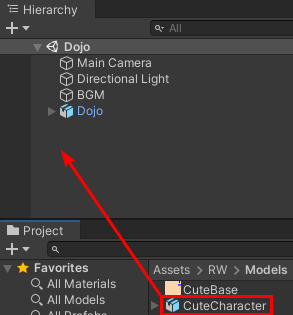
Now set the rotation of CuteCharacter to (X:0, Y:180, Z:0), and so information technology's facing towards the camera. Next, create a new animation controller past right-clicking the RW\Animations folder and selecting Create > Animation Controller.
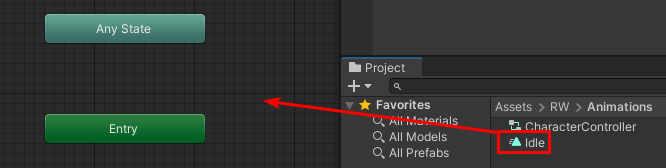
Name it CharacterController and double-click it to open the Animator window. Now elevate the Idle blitheness from the RW\Animations folder onto the Animator filigree to brand it the default animation.
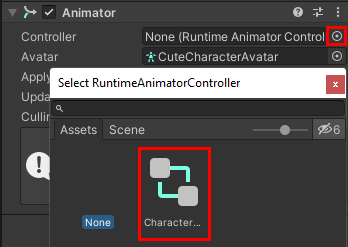
Next, select CuteCharacter in the Bureaucracy and click the selector push next to the Controller field. Select CharacterController in the selection window.
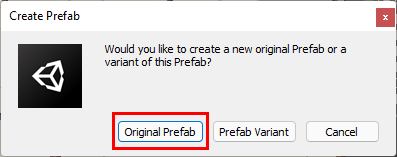
As a final pace, you'll need to attach the weapon the character's right hand. To do this, starting time off by make the character into a prefab past creating a new Prefabs folder in the Assets/RW folder and dragging CuteCharacter to it.
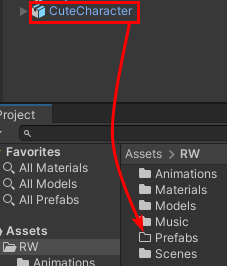
A popup will appear asking you what type of prefab you want to create, select Original Prefab here.
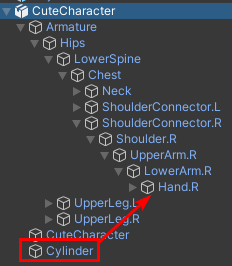
Now double click the CuteCharacter prefab you merely created to open it in Prefab Way. Aggrandize CuteCharacter in the Hierarchy and drag Cylinder to Hand_R to parent it. This is the limitation of adding a separate object as I discussed earlier. Not doing this volition result in the weapon just floating around the character.
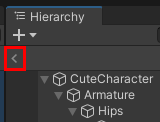
Now exit Prefab Way by clicking the arrow push below the + push button at the top left of the Hierarchy.
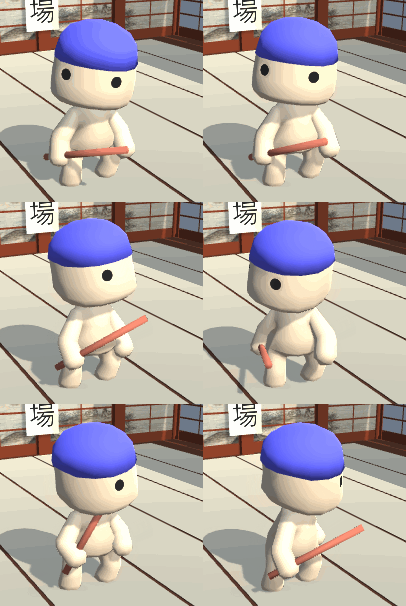
That'southward information technology! Press the play button to see the character in movement.
Now press the play push again to end the scene and press CTRL + Southward to save the changes yous've made.
Where to Get From Here?
Congratulations on finishing this tutorial. Yous tin can download the final projection using the link at the top or bottom of this tutorial.
In this tutorial, you lot learned how to:
- Create an armature (skeleton) for a character and rig it
- Change the character with accessories and objects
- Export to FBX
- Import Blender models
- Create and tweak a humanoid avatar
- Attach objects to a grapheme
- Animate a humanoid in Unity
To use the knowledge you've gained, you tin can create some accessories yourself and give them a dissimilar color or pattern. If you know some modeling, you can besides create a character from scratch and rig information technology.
To larn more about Blender, cheque out these tutorials:
- Official Blender Tutorials.
- Blender Guru'south iii.0 Beginner Series.
To learn more about Mecanim and the Avatar organization, read this blog mail by Unity.
Thank you then much for reading this tutorial to the cease. If y'all take any questions or comments, experience free to join the discussion below.
Source: https://www.raywenderlich.com/31539225-creating-reusable-characters-with-blender-and-unity
Posted by: edwardsperes1992.blogspot.com
0 Response to "How To Make Anime Full Body Characters In Blender"
Post a Comment